The AI Playbook for the Mittelstand
How Mittelstand leadership teams turn AI into a real capability: access instead of bans, data as an edge, sharp prioritisation and governance with judgment. Five steps.
By Nao IntelligencePublished Updated
Take the playbook with you
Five steps, ~8 minutes to read, as a designed PDF for your leadership team. We'll send it straight to your inbox.
The edge from a new tool rarely lasts. Once everyone uses the same technology, the advantage disappears, the way CAD and ERP became a standard in the 90s, not a source of competitive advantage. AI is no different. So the question isn't "Should we use AI?" but: How do we turn AI into a capability competitors can't simply copy?
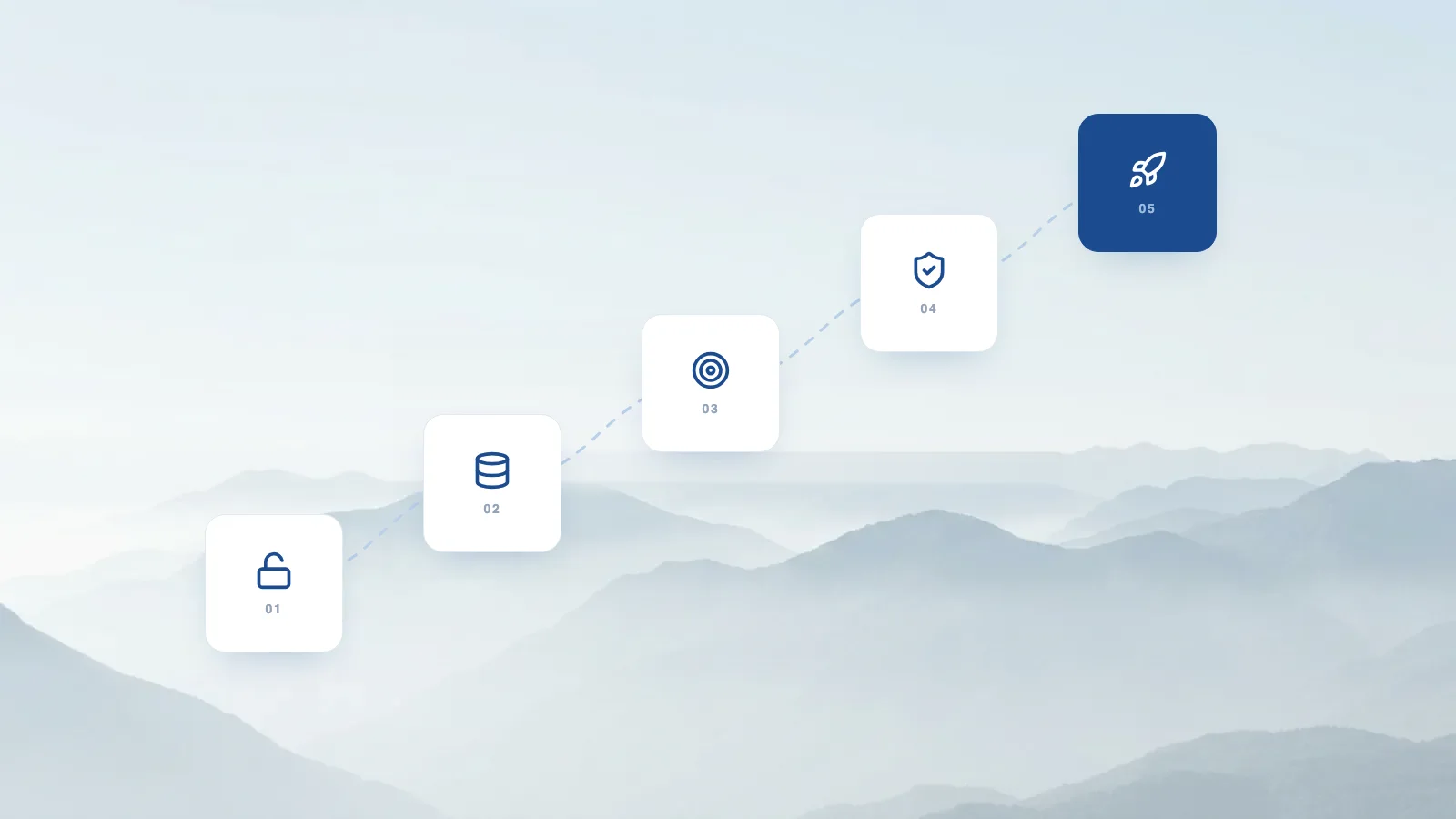
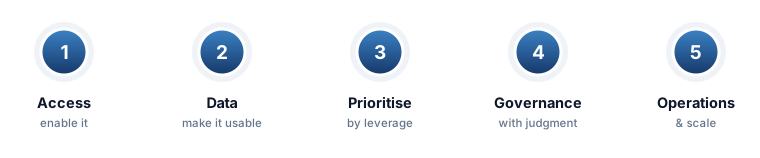
The pressure is real: in many industries, small AI-native players are appearing that keep pace with a fraction of the headcount. Waiting isn't an option. But neither is blind activism. This playbook sums up five steps that work for leadership teams in the Mittelstand.
1. Create access, don't ban it
Your people already use AI, just privately and uncontrolled, if you don't make it official. That's the real risk: shadow AI. Ban AI and you drive it underground, where company data flows into any tool at hand.
The better path is a vetted, GDPR-compliant platform for everyone, plus clear guardrails for the few genuinely critical risks (personal and regulated data). That keeps control where it matters, without choking off every idea. If usage stalls on a compliance form, you're only as fast as your slowest approval desk, and you lose to competitors whose teams are already experimenting.
More on this: AI adoption, Private AI platforms and RAG and the EU AI Act.
2. Your data is your edge
Anyone can rent a model. What your competitor doesn't have is your data: quotes, service cases, engineering know-how, machine data, decades of email history. That's your own raw material. But only if it's findable and usable.
Two steps make it usable: first, bring together the scattered data that today sits in ERP, CRM, line-of-business systems and file shares. Second, start capturing data you currently throw away. The data streams you don't collect now will be missing tomorrow.
More on this: Getting started with AI.
3. Prioritise what AI actually takes over
Not every task suits AI, and not every task that suits it is worth it. Two questions bring clarity:
- Where does AI do the work better, or at least as well? (e.g. searching documents, classifying requests, drafting.)
- What was too expensive or too slow before, but becomes feasible with AI? (e.g. reviewing every service case, following up on every quote individually.)
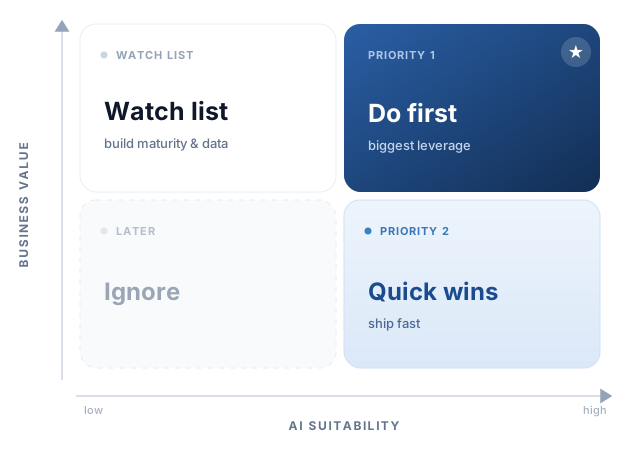
The answers turn into a prioritised list, ranked by value, feasibility and risk. That's exactly the core of a strategy project.
More on this: Getting started with AI, or start with the AI readiness check.
4. Govern with judgment
Governance doesn't mean securing everything until nothing works anymore. It means addressing the few real risks, and letting the rest run. Concretely:
- clear, understandable usage policies for staff,
- a human checks or approves critical decisions,
- traceable results instead of a black box,
- and taking the EU AI Act's AI-literacy obligation seriously (in force since February 2025), for example with training via the Nao Training Hub.
Route every use through IT approval instead, and you choke off exactly the innovation you were after.
More on this: EU AI Act.
5. Experiment, then move to production
An AI capability doesn't come from one big project, but from many small experiments with fast feedback. Encourage your teams to tackle real problems with AI, and create a place where they share what works.
The second part matters just as much: design the pilot from the start so it can move into production: cleanly built, integrated, with clear success criteria. A prototype that never goes live is expensive tuition.
More on this: AI development and AI adoption.
The playbook in one sentence
Create access, make your data usable, prioritise sharply, govern with judgment, keep learning. None of it is a mega-project, but together it becomes a capability that lasts.
What you can do next
-
Find out in three minutes where your company stands with the AI readiness check.
-
Read AI in the Mittelstand: where to start? for the methodical entry point.
-
Book a 30-minute initial call, and we'll help you work out which of the five steps comes first for you.


Not sure where to start?
Take the free AI readiness check. You'll know more in 3 minutes. Or talk to us directly in a no-obligation intro call.